

Epson GYROPLUS Technology
Taking Robot Performance to the Next Level
The addition of a gyro sensor at the end of the robot arm, providing continuous feedback to the robot controller, is a first in the industrial robot industry.
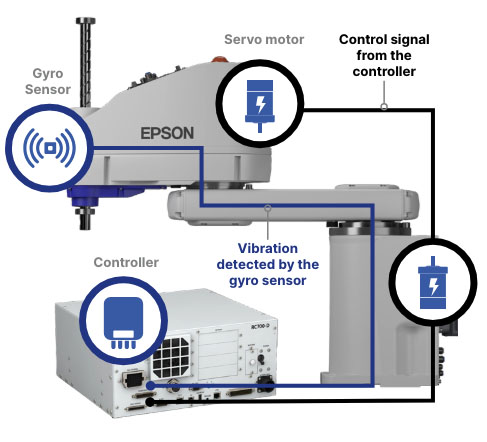 Traditional robot controls use angular velocity feedback located on the robot’s motor. But the true angular velocity at the end of the robot arm often differs from the motor’s angular velocity, due to mechanical tolerances, friction, and the influence of the attached load and peripherals such as end effectors and wiring. Now, with Epson’s GYROPLUS Technology mounted at the end of the robot arm, the robot controller receives information about the behavior directly at the end of the arm, so it can deliver motion commands to address the exact movement and position of the arm, rather than an estimate based on the motor’s angle and velocity. This means more precise control of positioning, along with significant vibration reduction.
GYROPLUS Technology also means that smaller, lighter-weight robot arms can now execute faster moves, handle heavier payloads, and provide better precision than traditional robots without this technology. In other words, machine builders and end users can get higher throughput and precision from their robotic automation solutions. And with Epson’s GYROPLUS Technology, SCARA and 6-Axis robots can now be used in applications that were previously inaccessible to these devices, due to precision, payload, and cycle time requirements that were just beyond the robots’ capabilities.